How Much Weight Do You Need? How to Choose Adjustable Dumbbells That Fit Your Training
What weight dumbbells should you buy? Compare 22 to 90 lb adjustable sets by exercise, goal and mechanism, and pick a ceiling you won't outgrow.
A full rack of fixed dumbbells takes up a wall, costs a small fortune, and still leaves you walking back and forth between sets. That is why so many people buying dumbbells for a home gym start with adjustable dumbbells instead: one compact adjustable dumbbell set that changes weight as you train. But the first decision trips up almost everyone. Adjustable sets run from light 22 lb starter kits to a 90 lb heavyweight set, and the right ceiling for a beginner doing lateral raises is completely wrong for someone deadlifting in their garage.
Pick too light and you will outgrow the set within months — legs and back get strong fast. Pick only by the biggest number and you may end up with a set whose lightest setting is too heavy for shoulder work. This guide settles the question in the order you should actually decide it: how much weight your exercises and goals really need, which adjustment style fits the way you train, and then how the options compare side by side.
The short answer: choose your ceiling first
If you only take one thing from this guide, take this: decide the heaviest weight you will realistically need in the next year or two, then check the lightest setting too. A good set covers both ends.
- Just starting out, toning, or returning after a break: a set topping out between 22 and 44 lb covers the learning phase comfortably and keeps the budget low.
- Training for general strength and muscle: a ceiling around 50 to 52.5 lb is the sweet spot. It handles presses, rows, squats and lunges for a long time.
- Already lifting, or planning years of progression: look at sets that build up to 90 lb, so your rows, squats and deadlift variations never run out of road.
And check the floor of the range, not just the ceiling. A plate-loaded set whose smallest build is 20 lb cannot give you a 10 lb lateral raise. Dial dumbbells that start at 5 lb can — which is why the range matters more than any single headline number.
How much weight do you need, exercise by exercise?
Your muscles do not all lift the same load. Your legs and back are far stronger than your shoulders, so one workout can legitimately span a 4-to-1 range of weights. These are sensible starting ranges for healthy adults — your own numbers will vary, and the right weight is always the one that makes the last two reps of a set challenging with clean form.
| Exercise | Typical starting range | As you get stronger |
|---|---|---|
| Lateral raises | 5–10 lb | 10–20 lb |
| Bicep curls | 10–20 lb | 20–35 lb |
| Overhead press | 15–25 lb | 25–45 lb |
| Floor or bench press | 20–35 lb | 35–60 lb |
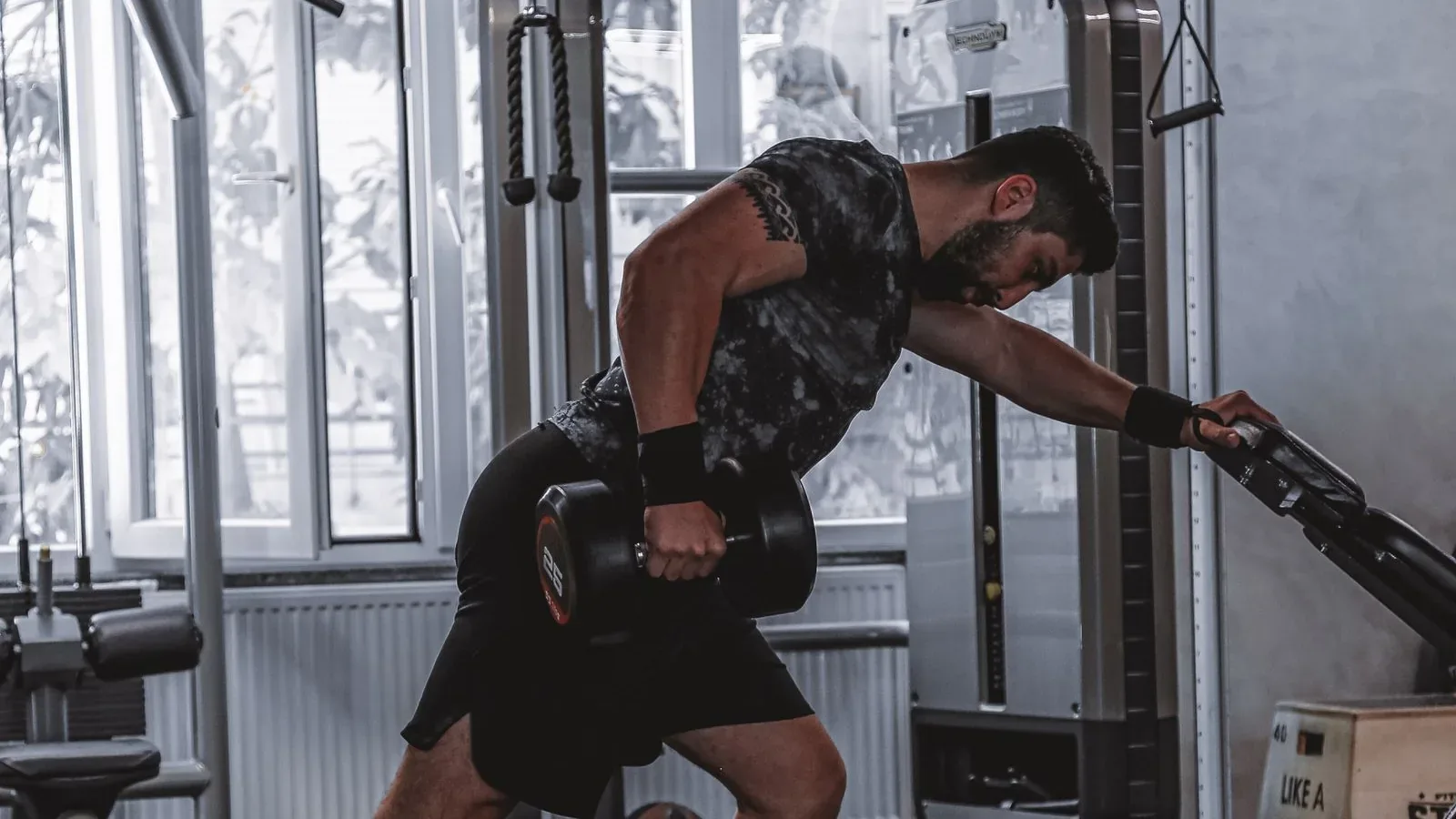
| One-arm rows | 25–40 lb | 40–70 lb |
| Goblet squats | 25–40 lb | 40–90 lb |
| Lunges | 15–30 lb | 30–60 lb |
| Romanian deadlifts | 25–45 lb | 45–90 lb |
Read the table the way you will actually train. Your shoulder work may never pass 20 lb, but your rows and goblet squats can run past 50 lb within a year of consistent training. That is why most people are happiest with a ceiling around 50 lb or above — and why the heaviest sets exist for lifters whose rows and deadlift variations keep climbing.
Match the weight to your goal
Toning and endurance. If you train in circuits with higher reps and short rests, lighter weights changed quickly matter more than a huge ceiling. The 2-in-1 Adjustable Dumbbell and Barbell Set, 22 lb or the 25 lb model of the quick-dial dumbbell below will cover months of productive training.
Building muscle. You need a mid-range ceiling and settings close enough together that you can add a little weight often. Sets topping out between 44 and 52.5 lb fit most muscle-building programs run at home.
Raw strength. Heavy rows, squats and presses at low reps eat weight quickly. A set that builds to 70 or 90 lb stops being a luxury and becomes the whole point.
Dial or plate-loaded: which adjustable dumbbells fit your training?
Once the weight range is settled, the second decision is how you change it. There are two families, and neither is simply "better" — they suit different training styles and budgets.
| Dial dumbbells | Plate-loaded sets | |
|---|---|---|
| Changing weight | Turn a dial while the dumbbell sits in its tray | Add or remove plates by hand and lock them on |
| Speed between sets | Seconds | About a minute |
| Extra uses | Dumbbell training | Often converts to a barbell or kettlebell |
| Budget | Higher | Lower |
| Best for | Fast workouts, supersets, small rooms | Starting out, mixing dumbbell and barbell work |
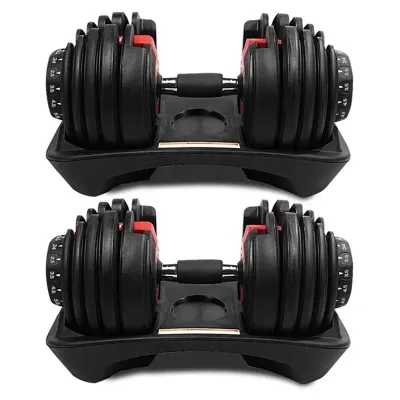
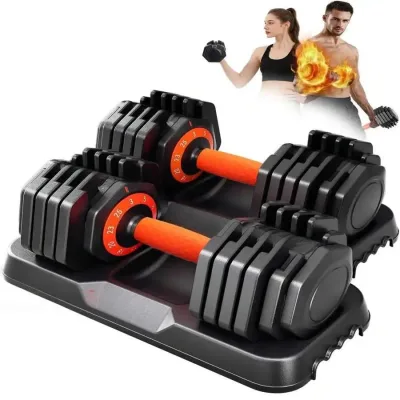
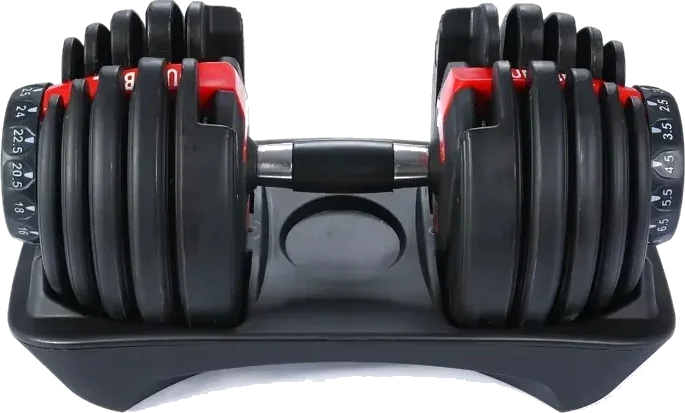
Choose a dial dumbbell if your workouts move quickly — supersets, circuits, drop sets — or if the set will live in a bedroom or living room where a tidy tray beats loose plates. The Quick-Dial Adjustable Dumbbell, 25 or 50 lb gives you ten settings in one handle, and the Adjustable Dial Dumbbell, 5 to 52.5 lb covers the full 5 to 52.5 lb range in a single dumbbell. One rule comes with every dial model: never drop it. The mechanism that makes changes instant has moving parts, so you set it down in its tray after every set.
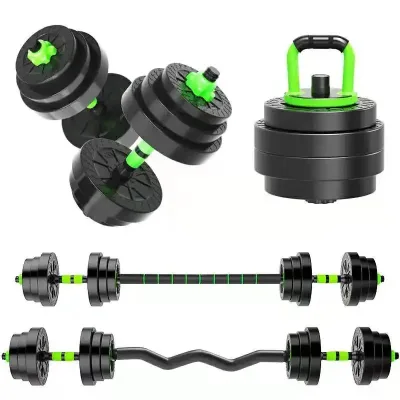
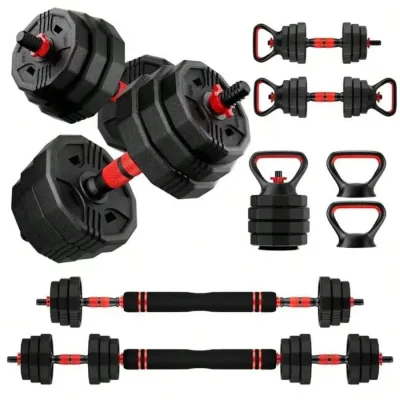
Choose a plate-loaded set if you want the most weight for your money, or more than one tool from a single purchase. The 4-in-1 Adjustable Dumbbell Set with Connector, 44 lb works as dumbbells, joins into a short barbell with the included connector, and swaps to kettlebell grips for swings and goblet squats. Plate sets are mechanically simple, easy to understand, and changing weight takes about a minute instead of seconds.
Every adjustable dumbbell set in the store, compared
Here is every adjustable set in the store, ordered by ceiling, with the facts that actually separate them. Prices are as listed on each product page.
| Set | Type | Weights you can make | Best for | Listed price |
|---|---|---|---|---|
| 2-in-1 Adjustable Dumbbell and Barbell Set, 22 lb | Plate-loaded set | Up to 22 lb total | Beginners, toning, warm-ups | $49.00 |
| Adjustable Barbell and Dumbbell Set, 40 lb | Plate-loaded set | Up to 40 lb (20 kg) total | Learning the main lifts | $89.00 |
| 4-in-1 Adjustable Dumbbell Set with Connector, 44 lb | Plate-loaded set | Up to 44 lb total; also barbell and kettlebell modes | Variety on a budget | $91.00 |
| Quick-Dial Adjustable Dumbbell, 25 or 50 lb | Single dial dumbbell, tray included | 10 settings, up to 25 lb or 50 lb by model | Fast changes in a small space | $549.00 |
| Adjustable Dial Dumbbell, 5 to 52.5 lb | Single dial dumbbell, own tray | 5 to 52.5 lb in one handle | The widest range in one handle | $449.00 |
| 5-in-1 Adjustable Dumbbell Set, up to 90 lb | Plate-loaded set | Builds 20, 30, 45, 70 or 90 lb | Heavy progression, most weight per dollar | $549.00 |
Two details worth noticing. First, the two dial models are single dumbbells — ideal if you train a lot of one-arm work, and easy to pair up later. Second, the 90 lb set's steps are wide (45 to 70 to 90 lb), which suits heavy compound lifts; if your training lives in the 20 to 50 lb zone, the dial models give you finer steps where you will actually use them.
Dumbbells for a home gym: space, storage and your floor
Space is the reason adjustable sets exist. A dial dumbbell in its tray takes up about as much floor as a carry-on bag, and the plates you are not using stay locked inside the tray instead of spreading across the room. Plate-loaded sets need a corner for the plates, but the lighter kits are genuinely small — the 22 lb set stores in a cupboard, and most sets tuck under a bed or on a shelf between sessions.
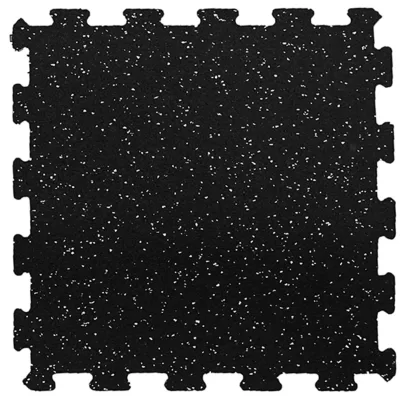
Whatever you choose, protect the surface underneath. Even careful lifters set weights down hard at the end of a tough set, and repeated contact dents wood and cracks tile. A layer of Interlocking Gym Floor Mats, 1/2 in Thick under your training area spreads the load, grips your shoes, and keeps early-morning workouts quieter for everyone else in the house.
Five mistakes to avoid
- Buying for your first month instead of your first year. Beginners outgrow light sets on rows, squats and lunges long before they outgrow them on curls. Look at your heaviest dumbbell lift today and choose a set that goes clearly above it.
- Ignoring the bottom of the range. A set that starts at 20 lb feels fine until your program asks for a 10 lb lateral raise. If you do a lot of shoulder and rehab work, a low starting weight matters.
- Chasing the biggest number. A 90 lb ceiling you never approach buys you wide jumps between settings you do use. Match the ceiling to your strongest lifts, not your ambitions for five years from now.
- Dropping dial dumbbells. They are built to be set down, not dropped. Return the dumbbell to its tray before turning the dial, and make sure both dials show the same number before you lift.
- Skipping the delivery and returns details. Heavy equipment is the last thing you want to gamble on. Check the shipping policy and returns policy before you order — here, orders ship within the contiguous United States and unused items can be returned within 30 days.
Ready to choose?
You now know your ceiling, your floor, and your mechanism. Browse the full range of adjustable dumbbells, compare the settings on each product page, and pick the adjustable dumbbell set that fits the way you will actually train — not just the way you trained last month. Every order is covered against manufacturing defects, and if you are torn between two sets, send us a message before you buy and we will help you choose.
Questions & answers
What weight dumbbells should a beginner buy?
Start light enough to learn the movements with clean form: roughly 5 to 15 lb for upper-body work and 15 to 30 lb for legs is a sensible first range. Adjustable dumbbells for beginners should start around 5 lb, or come as a plate-loaded set in the 22 to 44 lb range, so they cover that phase without forcing a second purchase a few months later.
Is a 50 lb adjustable dumbbell enough?
For most home lifters, yes — for a long time. A 50 to 52.5 lb ceiling handles presses, rows, lunges and goblet squats through the beginner and intermediate stages. It stops being enough when your one-arm rows and deadlift variations regularly pass 50 lb per hand, which is exactly who the 90 lb set is built for.
Dial or plate-loaded: which is better?
Neither — they trade speed for price and versatility. Dial dumbbells change weight in seconds and live neatly in a tray, but cost more and must never be dropped. Plate-loaded sets take about a minute to change, cost less per pound, and often convert into a barbell or kettlebell as well.
Can you drop adjustable dumbbells?
Dial models, no — they have moving parts and should always be set down in their tray. Plate-loaded sets are mechanically simpler, but the same habit protects both the equipment and your floor: set weights down, ideally on mats, rather than dropping them.
What if I outgrow my set?
That is the argument for buying headroom up front: your set should go clearly above your current heaviest lift. If you love the convertible format, note that the supplier of the 4-in-1 set also lists 66 lb and 88 lb versions — send us a message if you want one of those instead.
Do adjustable dumbbells come in pairs, or are they sold singly?
It depends on the type. The two dial models in this store are single dumbbells, which suits one-arm work like rows and can be paired up later. The plate-loaded sets are sold as one set of plates and handles, and the weight in the name — 22, 40, 44 or 90 lb — is the set's total, shared across the dumbbells and other tools you build from it.
How much space do adjustable dumbbells take up?
Very little — that is their main advantage over a fixed rack. A dial dumbbell in its tray takes up about as much floor as a carry-on bag, and the plates you are not using stay locked inside the tray. Plate-loaded sets need a small corner for their plates, and the lightest kit, the 22 lb set, stores in a cupboard.
How fast will my order arrive, and can I return it?
We ship to the contiguous United States, and most orders arrive within 3 to 7 business days with a tracking number emailed when your order ships. Unused items in their original packaging can be returned within 30 days of delivery. More detail lives on our frequently asked questions page.